Small business owners rarely end up buried in debt because of one bad decision. It’s usually a chain of them — a slow season, a gap in cash flow, and then the fast, expensive financing that seems like the only way to keep the doors open. That’s exactly the pattern we saw in one of our recent Subchapter V reorganization cases.
The situation
This business had defaulted on an SBA-guaranteed loan — one of the most serious forms of debt a small business can carry, since SBA lenders have significant leverage to pursue repayment. On top of that, the business had taken out multiple rounds of merchant cash advances from the same MCA lender, a pattern known as “stacking,” where a business takes a second or third advance before the first is paid off. Stacking often starts as a short-term fix and ends as an accelerating spiral, since each new advance comes with its own daily or weekly repayment draw.
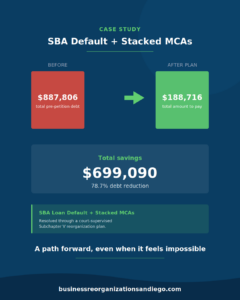
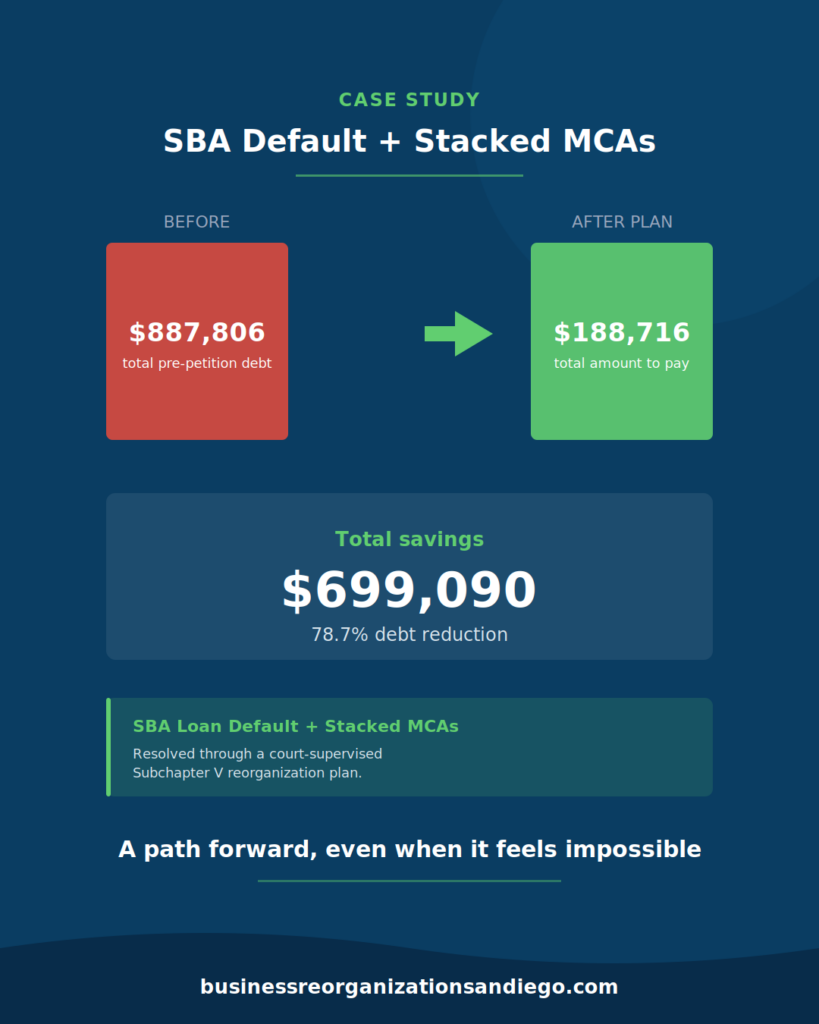
By the time the business came to us, it was carrying $887,806 in total pre-petition debt across more than a dozen creditors — the SBA loan, two stacked merchant cash advances, several major bank and credit card obligations, and a handful of trade creditors who were owed for goods and services already delivered.
How a Subchapter V case actually works
The process begins with a complete inventory of all creditors and outstanding debts. The attorney and bookkeeper then work together to prepare a proposed repayment plan, along with financial documentation of the business’s income, which is used to negotiate feasibility with the Subchapter V Trustee.
All creditors are formally notified of the case and given the opportunity to file a Proof of Claim, asserting and substantiating any secured interest in the debtor’s assets. Once claims are established, the attorney, Trustee, and client meet to finalize the Plan of Reorganization — determining the secured payment amount, the unsecured dividend rate (cents on the dollar), and the estimated timeline for repayment to all creditors.
Throughout the process, the business continues operating, and ownership retains control of day-to-day decisions.
The result
| Amount | |
|---|---|
| Total pre-petition debt | $887,806 |
| Total amount to pay under the plan | $188,716 |
| Total savings | $699,090 |
| Reduction | 78.7% |
The plan paid administrative claims — bookkeeper, Subchapter V Trustee, and bankruptcy counsel — in full, as required, while resolving general unsecured debt, including both stacked MCAs, at a dividend rate of roughly 12 cents on the dollar.
Why this matters for other business owners
Stacked MCAs and SBA loan default are two of the most common reasons small businesses end up in serious financial distress — and two of the situations business owners are most likely to assume are unfixable. They aren’t. A Subchapter V reorganization is a legal, court-supervised process built to give small businesses exactly this kind of second chance: real debt relief, without losing the business itself.
If your business is carrying stacked merchant cash advances, has defaulted on an SBA loan, or is fielding calls from creditors you can’t keep up with, it’s worth understanding your options before the debt makes that decision for you.
Results discussed in this case study are not guaranteed. Every case is different, and outcomes depend on each client’s specific financial situation, creditors, and circumstances. Past results do not predict future outcomes.